

Deep Clean vs Recurring Cleaning: Statesboro Guide
- Statesboro: Deep clean is a top-to-bottom reset; recurring cleaning maintains an established standard and prevents backlog.
- Need a deep clean if over four months without thorough cleaning, mildew, allergies worsen, moving, or hosting; Bulloch County pollen matters.
- Hubbard's Maid Service: a one-time deep clean plus biweekly maintenance is often cheaper yearly than skipping the reset.
Almost every Statesboro homeowner who calls us asks some version of the same question: “Do I need a deep clean, or can I just start regular cleaning?” It is a fair question, and the answer has real money attached to it — the wrong choice either wastes a few hundred dollars or leaves you paying for maintenance visits that never quite get your house where you wanted it.
Here is how the two services actually differ, how to tell which one your Statesboro home needs right now, and when you can honestly skip the deep clean altogether.
Deep cleaning vs. recurring cleaning: the real difference
People assume the difference is effort — that a deep clean is a recurring clean done harder. It is not. The difference is scope and direction.
A Top-to-Bottom deep cleaning is a reset. It works on the surfaces that accumulate slowly and are never reachable in a normal visit: soap scum built into shower grout, dust bonded to ceiling fan blades, the greasy film above the range hood, window tracks, door frames, baseboards, behind and under furniture, and the edges of hard floors where mopping never quite reaches. It is measured in hours and it is thorough by design.
A recurring maintenance cleaning is upkeep. It holds a home at a standard that has already been established: bathrooms, kitchen, floors, dusting, surfaces, high-touch points, done consistently on a schedule. It is efficient precisely because it is not fighting a backlog.
The practical consequence: recurring cleaning maintains a level; it does not create one. If your home is currently below the level you want, recurring visits alone will take months to close the gap — and you will pay for those months.
What each service actually covers
A deep clean typically includes
- Shower and tub detail work, including grout lines and glass treated for hard-water and soap-scum buildup
- Baseboards, door frames, switch plates, and window sills hand-wiped
- Ceiling fans, vents, and light fixtures dusted
- Kitchen cabinet fronts and the grease film on surfaces near the cooktop
- Behind and beneath movable furniture; floor edges and corners
- Window tracks and sills — a specific Lowcountry problem, because they collect pollen and hold moisture
What a deep clean generally does not include
This is where expectations go sideways, so let’s be plain. Unless you specifically add them, a deep clean does not cover the inside of your oven or refrigerator, exterior windows, carpet extraction, tile-and-grout restoration, wall washing, or organizing your belongings. Those are either add-ons or separate trades. Ask, and get the answer in writing.
A recurring clean typically includes
- All bathrooms cleaned and sanitized
- Kitchen surfaces, cooktop, sink, and appliance exteriors
- Vacuuming and damp-mopping all floors with a solution suited to the floor type
- Dusting reachable surfaces; high-touch points wiped
- Beds made, trash emptied, rooms straightened
- Rotating detail items so nothing goes untouched for long
Which one does your Statesboro home need?
Use these tests. They are the same ones our team uses on a walkthrough.
You need a deep clean first if…
- It has been more than about four months since anyone cleaned thoroughly — or you cannot remember the last time the baseboards were wiped.
- You can see a haze on the shower glass that does not come off with everyday spray. That is mineral scale plus soap film, and it needs dwell time and the right chemistry, not more elbow grease.
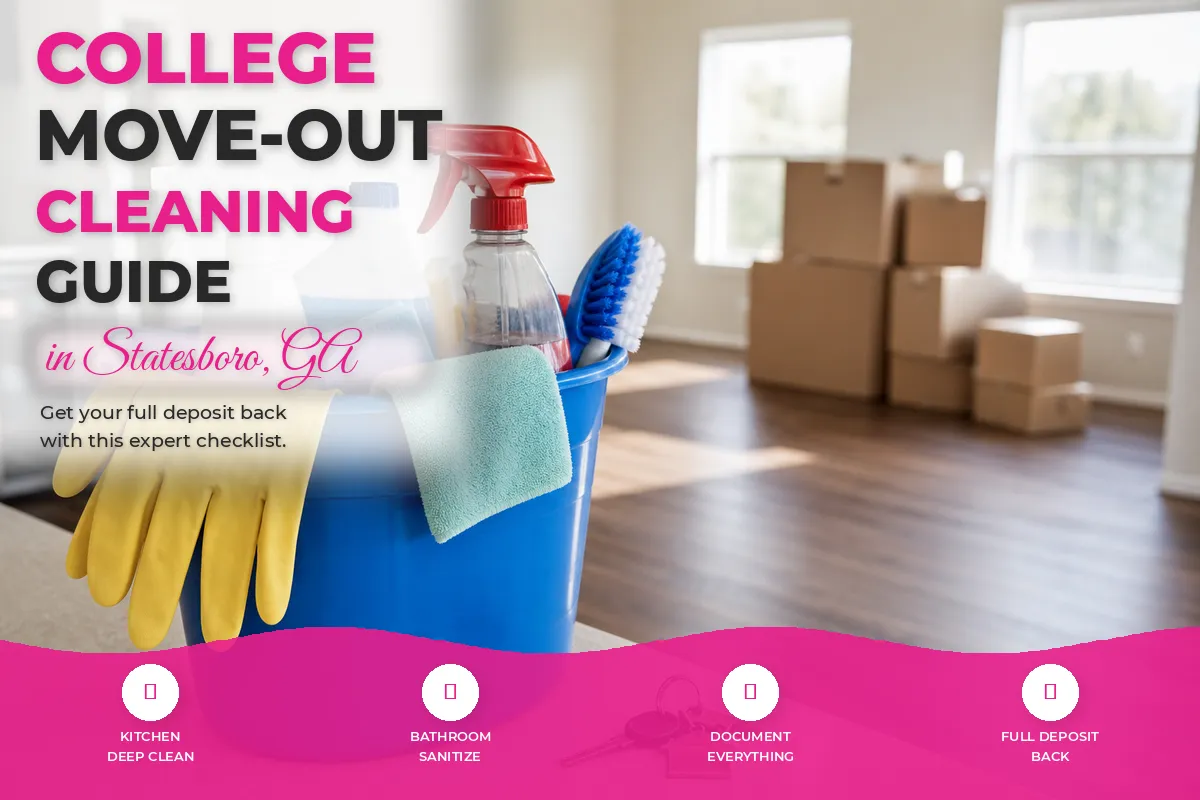
- You are moving in or out. Empty homes get their own service — see vacant home cleaning — and for a rental, a proper move-out clean is usually cheaper than a disputed deposit.
- Someone in the house has allergies or asthma and spring has just ended. Bulloch County’s oak and pine pollen load is heavy, and settled pollen keeps recirculating from soft surfaces and window tracks until it is physically removed. The EPA notes that source removal is the most effective indoor air quality strategy — which is exactly what a deep clean does.
- There is mildew in the grout or on window frames. Statesboro summers are humid enough for mildew to establish itself indoors within weeks. A recurring visit does not have the hours to address established growth.
- You are hosting. Football weekends and Georgia Southern family visits create a hard deadline, and a deep clean puts the whole house at one level at once.
You can start straight into recurring cleaning if…
- You have been keeping up. If someone in the household has cleaned bathrooms and floors consistently in the last month, a maintenance visit will hold that fine.
- You just had a deep clean — from us or anyone else — within the last six to eight weeks.
- Your home is new or newly cleaned after construction, assuming the construction dust has already been dealt with.
- Your budget is the binding constraint. Honest truth: if you can afford either a one-time deep clean or three months of biweekly service but not both, biweekly service will usually make your daily life better. The deep-clean items are the ones you notice least day to day. Book the deep clean later, when it fits.
How the money actually works
A deep clean costs more than a recurring visit because it takes more hours — commonly two to three times the labor of a maintenance visit on the same home. Our recurring maintenance cleaning generally runs $150 to $260 per visit for a typical home in our service area, with the exact figure set after a walkthrough, because bathroom count, floor type, pets, and condition matter far more than square footage.
What surprises people is the sequencing math. A deep clean followed by biweekly maintenance is usually less expensive over a year than skipping the deep clean and asking recurring visits to slowly catch up, because those catch-up visits run long for months. The deep clean is not an upsell; it is the cheapest way to make maintenance visits efficient.
The other lever is frequency. Biweekly service costs less per visit than monthly, because a home cleaned every two weeks never drifts far. Monthly service is genuinely harder work each time. If you are choosing between “monthly full house” and “biweekly, slightly smaller scope,” we would steer you to biweekly nearly every time.
Statesboro-specific things worth knowing
- Humidity is the local variable. Keep indoor humidity near 50% and run bath fans for 20 minutes after showers. This single habit slows mildew more than any product, and it lowers your cleaning labor over time.
- Pollen has a season and a strategy. Late February through April, add a mid-season deep clean rather than paying for longer visits year-round. Wipe window tracks; they are the reservoir.
- Rental turnover is a real calendar. Around Georgia Southern’s move-out weeks, deep-clean and move-out slots fill first. Book two to three weeks ahead.
- Red clay and sandy soil track in differently. Grit acts like sandpaper on hard floors, so entry mats and consistent vacuuming of floor edges protect your finish — a maintenance question, not a deep-clean one.
- Hurricane season means power and moisture events. After a multi-day outage in August or September, homes that sat without air conditioning often need a deep clean rather than a maintenance visit, because everything got damp at once.
Common questions we get before the first visit
Do I have to be home?
No. Most of our recurring clients are at work. We arrange access however you prefer — a lockbox, a code, a key on file — and our cleaners are employees who are background checked, and the company is licensed, bonded, and insured. For a first deep clean, many people do like to be home for the first 15 minutes to point out priorities, and that is genuinely useful.
Will one deep clean fix mildew in my grout permanently?
Honestly, no. A deep clean removes what is on the surface and in the pores it can reach, but grout that has been colonized for years may stay discolored, and it will return if the moisture stays. That is a humidity problem, not a cleaning problem. We will tell you when you are looking at a re-grout or a sealing job rather than more cleaning hours.
What if I need to skip a visit?
Life happens — travel, illness, a house full of guests. Skipping the occasional visit is fine; just give us as much notice as you can so we can offer that slot to someone else. Do know that a skipped visit makes the next one a little heavier, especially in summer.
Can I book a deep clean once a year and nothing else?
Yes, and for some households that is genuinely the right plan. Annual or twice-yearly deep cleans work well for people who keep up day to day but do not want to tackle fans, baseboards, and shower glass themselves. There is no requirement to sign up for recurring service.
The simple rule
Deep clean to establish a standard. Recurring cleaning to keep it. If your home is already where you want it, start recurring. If it is not, one reset will save you money and frustration — and if we walk through your home and think you can skip the deep clean, we will say so.
Hubbard’s Maid Service has cleaned Georgia and South Carolina homes since 2004 and holds more than 800 five-star Google reviews, and we work with plenty of families across Statesboro and Bulloch County. If you want a straight answer on which service fits, call (912) 961-9131 or request a quote. We will price both options and tell you which one we would choose in your position. Current offers are always on our specials page.
— Nicole Hubbard, founder of Hubbard’s Maid Service.
Share this article
Related Posts


Follow us
A quick overview of the topics covered in this article.