


Cleaning Service vs Independent Cleaner in Pooler
- Independent cleaner often costs less but transfers more risk; verify insurance, backup plans, and tax implications before hiring.
- Cleaning service charges more but provides trained teams, written checklists, and workers' compensation plus liability coverage.
- Ask both for a certificate of insurance, who will enter your home, cancellation backup, and references in Pooler.
Post a question in any Pooler neighborhood Facebook group — Godley Station, Savannah Quarters, Westbrook, take your pick — asking for a house cleaner, and within an hour you’ll have twenty replies. Half will recommend “my cleaning lady, she’s amazing,” and the other half will tag a cleaning company. Both camps are sincere. So which should you actually hire?
I’ve owned a cleaning company in this area since 2004, so you can fairly assume I have an opinion. But I’ve also watched plenty of independent cleaners do excellent work, and I’d be doing you a disservice if I pretended a company is always the better choice. This guide lays out the honest trade-offs between hiring an independent house cleaner and a professional cleaning service in Pooler — what you gain, what you risk, and the questions that tell you which one fits your home.
Cleaning Service vs Independent Cleaner: The Short Version
If you only read one section, read this one:
- An independent cleaner is one person (sometimes with a helper) who sets their own rates and schedule. You often pay less per visit, you build a direct relationship, and when it works, it works beautifully. The trade-off is that you carry more of the risk — insurance, backup coverage, and, in some situations, tax paperwork.
- A cleaning service employs, trains, insures, and schedules a team. You typically pay more per visit, and you’re buying a system: consistent checklists, workers’ compensation and liability coverage, someone to send when your regular cleaner is out, and a company that has to answer for the result.
Neither is automatically better. The right choice depends on what you value most and how much risk you’re comfortable holding.
Price: Why Independent Cleaners Often Quote Less
Let’s start where most people start. In our experience, independent cleaners around Pooler and greater Savannah often quote less per visit than established companies. That’s not because companies are padding the bill. It’s because a legitimate company’s price has to cover things an independent may not carry:
- Workers’ compensation and general liability insurance
- Bonding
- Payroll taxes and properly reported wages
- Paid training time and supervision
- Professional equipment, replacement microfiber, and commercial vacuum maintenance
- Office staff who answer the phone, reschedule, and handle problems
For reference, most of our Pooler clients on a recurring maintenance cleaning plan pay between $150 and $260 per visit, depending on bathrooms, floors, pets, and frequency. When you compare that to an independent’s quote, compare the full package — not just the number.
Insurance and Liability: The Question Most People Skip
This is the single biggest difference, and it’s the one homeowners think about least until something goes wrong.
If a cleaner gets hurt in your home
Cleaning is physical work. People slip on wet tile, strain backs moving furniture, and fall off step stools reaching ceiling fans. When a company’s employee is injured, their workers’ compensation policy responds. When an uninsured independent is injured, the question of who pays can land on the homeowner. Whether your homeowner’s policy covers it depends entirely on your policy, so if you hire independently, call your insurance agent and ask that question directly.
If something gets broken or damaged
Accidents happen even with the most careful cleaners — a lamp gets knocked, the wrong product touches a natural stone counter. A bonded and insured company has a process and coverage for that. With an independent, you’re relying on their personal willingness and ability to make it right.
How to check
Whoever you hire, ask for a certificate of insurance. A legitimate company can send one quickly. Hubbard’s Maid Service is licensed, bonded, and insured, and our house cleaners are covered by workers’ compensation — and every cleaner who enters your home is our trained, background-checked employee, never a subcontractor.
Taxes: The Household Employer Issue Nobody Mentions
This one surprises people. Depending on how the arrangement works, the IRS may consider a house cleaner who works for you to be your household employee rather than an independent contractor — generally when you control what work is done and how it’s done. If you pay a household employee cash wages above an annual threshold, you may be responsible for withholding and paying Social Security and Medicare taxes.
Plenty of independent cleaners genuinely run their own businesses, set their own methods, and serve many clients, so this won’t apply to every arrangement. But if you’re hiring someone directly, read IRS Publication 926, the Household Employer’s Tax Guide, which lists the current threshold, or ask your tax preparer. When you hire a company, the company is the employer and handles all of it.
Consistency and Backup: What Happens When Your Cleaner Is Out?
An independent cleaner who’s sick, on vacation, or has a family emergency simply can’t come — and in Pooler, where so many of our clients work at Gulfstream, the port, the airport, or in Savannah and juggle tight schedules, a missed clean right before guests arrive is a real problem.
A company can send another trained team. The trade-off is that you may not always see the exact same faces, which is why we work hard to keep clients with a consistent team — most of our recurring clients see the same people visit after visit, and the team learns your home, your preferences, and which bedroom door sticks.
Ask any independent you’re considering: “What happens if you can’t make it?” A thoughtful answer — a trusted backup, a make-up day — is a good sign.
Quality and Training: Who Checks the Work?
A great independent cleaner can absolutely out-clean a mediocre company. The difference isn’t talent; it’s systems. A professional service should have:
- A written room-by-room checklist, so the visit doesn’t depend on what someone remembers that day.
- Training on surfaces and chemistry — why you never put vinegar on the granite and quartz that’s in so many newer Pooler kitchens, why bleach and ammonia must never be mixed, and how to cut hard-water and soap scum without etching glass.
- Supervision and quality checks.
- A guarantee with teeth. At Hubbard’s, if something was overlooked, contact us within 24 hours and we’ll come back and make it right at no charge.
With an independent, you are the quality control. For some people that’s fine; for busy households, it’s one more job.
Pooler Conditions That Change the Equation
A few local realities matter here:
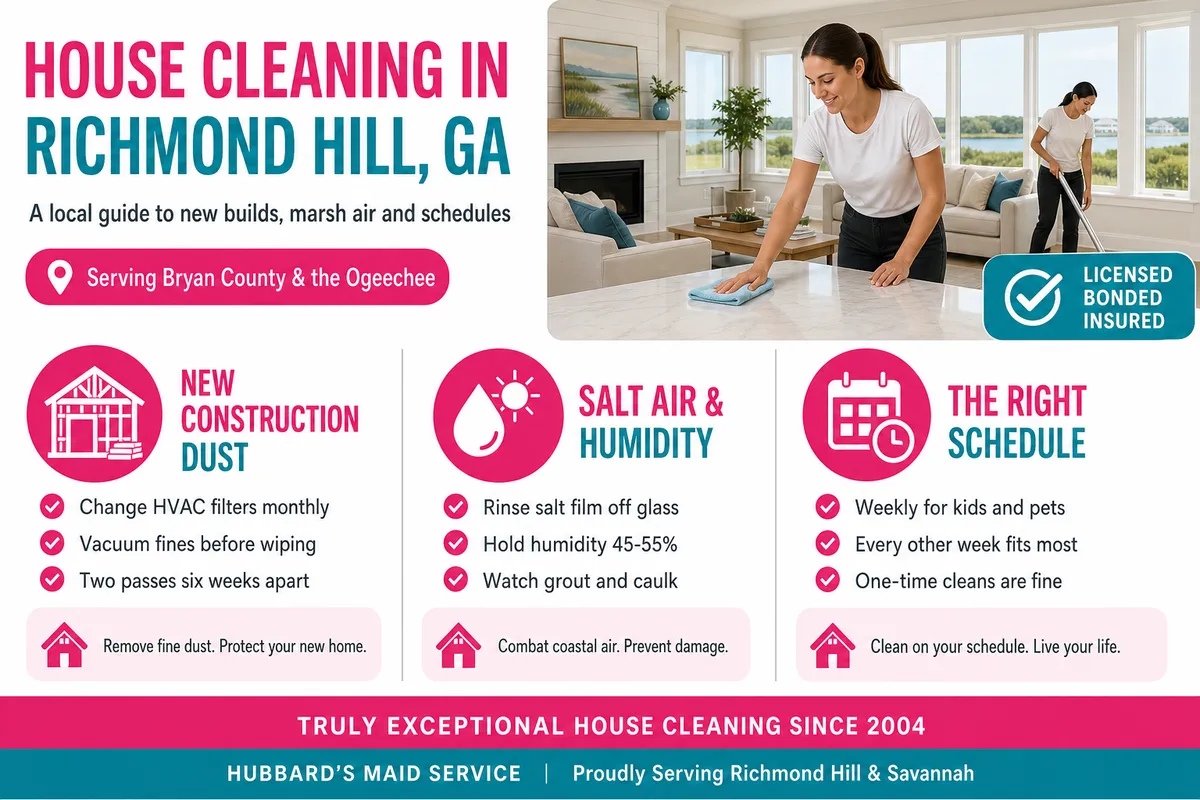
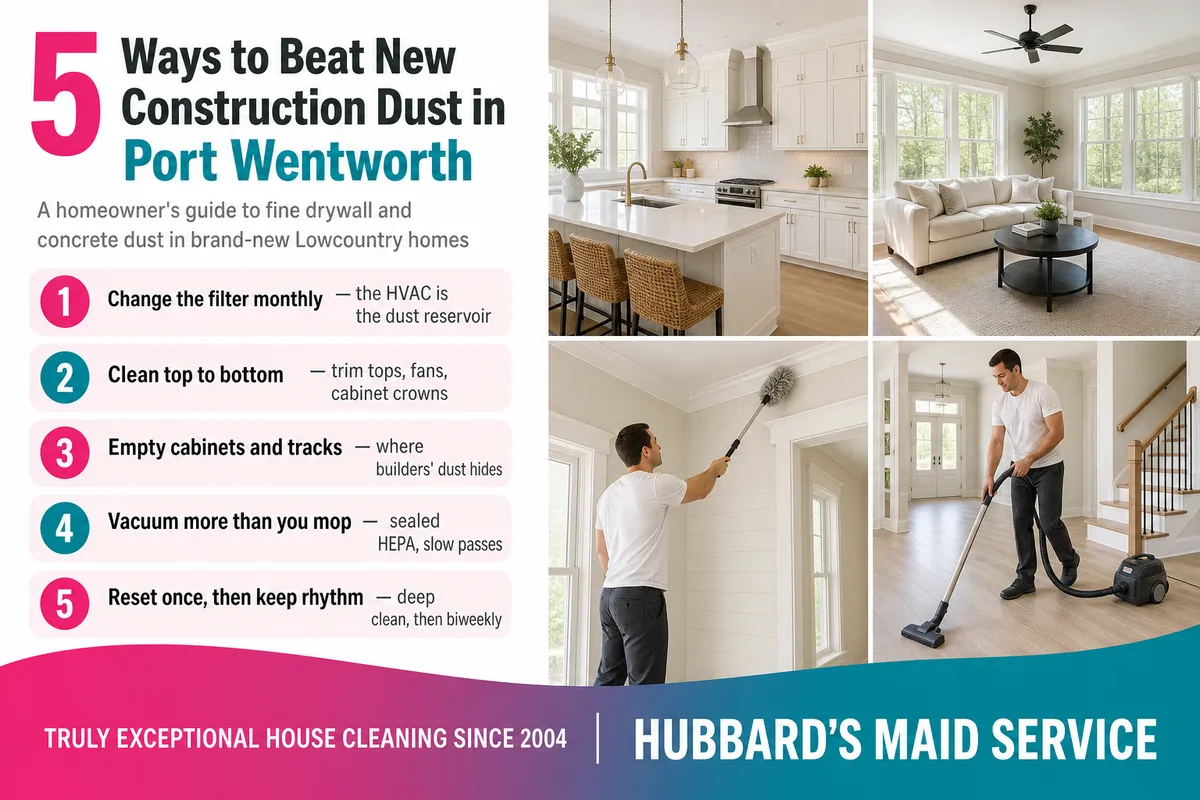
- New construction dust. Pooler keeps building, and new homes keep shedding drywall dust from vents and baseboards for months. Microfiber, top-down dusting, and HEPA vacuums matter.
- Humidity and mildew. Coastal Georgia summers push mildew into grout and caulk fast. Consistent, correctly trained cleaning prevents expensive re-grouting later.
- Pollen season. Oak and pine pollen from late winter into spring coats sills, porches, and ceiling fans. Frequency matters more than intensity.
- Move-in and move-out timing. With military families and a busy rental market, many Pooler homes need a deep reset on a tight deadline. That’s where a company’s ability to schedule a full team is hardest for one person to match. If that’s your situation, a Top-to-Bottom deep cleaning or vacant home cleaning is designed for exactly that.
When an Independent Cleaner Is the Better Choice
Here’s the honest part. An independent may be the right call when:
- You’ve found someone with a long, verifiable track record and references you can actually call.
- They carry their own liability insurance and can show you the certificate.
- You want a flexible, informal arrangement and you’re comfortable handling quality checks and backup plans yourself.
- Your budget simply doesn’t stretch to a company rate, and a smaller, insured independent fits.
If that describes your situation, go for it, and treat them well — good cleaners are worth keeping.
When a Cleaning Service Is the Better Choice
- You want insurance, workers’ comp, and taxes handled without thinking about them.
- Your schedule can’t absorb missed cleans.
- You want a written scope, a consistent checklist, and someone accountable if something’s missed.
- You’re juggling a big reset — a move, a new build, or a house that’s gotten away from you.
Five Questions to Ask Either One Before You Hire
- Can you send me proof of liability insurance — and do you carry workers’ compensation?
- Who exactly will be in my home, and are they background-checked?
- What’s included in a regular visit, and what costs extra?
- What happens if you can’t make it, or if I’m not happy with something?
- Can I read reviews or talk to current clients?
Any cleaner — independent or company — who answers those clearly and without defensiveness is worth a serious look. You can read what our own clients say on our reviews page; we’ve earned more than 800 five-star Google reviews since 2004, and you can find answers to common questions on our FAQ page.
Ready to Compare?
If you’re weighing your options, we’re happy to give you a written, flat per-visit quote so you can compare apples to apples. Learn more about how we serve the area on our Pooler house cleaning page, check our current specials, call us at (912) 961-9131, or request a free quote online. No pressure — just honest answers.
— Nicole Hubbard, founder of Hubbard’s Maid Service, cleaning Coastal Georgia and Lowcountry homes since 2004.
Share this article
Related Posts

Follow us
A quick overview of the topics covered in this article.